A meta-analysis landed last week and my first reaction was: so what? Then, looking further, it does get interesting.
Ninety two randomised trials found that ethics and moral education works better when people talk to each other than when you push information at them. Pause for “so-what” reaction… Okay, we have known that for decades, e.g. 70/20/10.
Then I came back to it, and I think a lot of us are about to make the same mistake with it.
What the study actually found
Published in Nature Human Behaviour on 26 August, a team including researchers at the University of Queensland pooled the randomised evidence on interventions designed to shift ethical and moral outcomes.
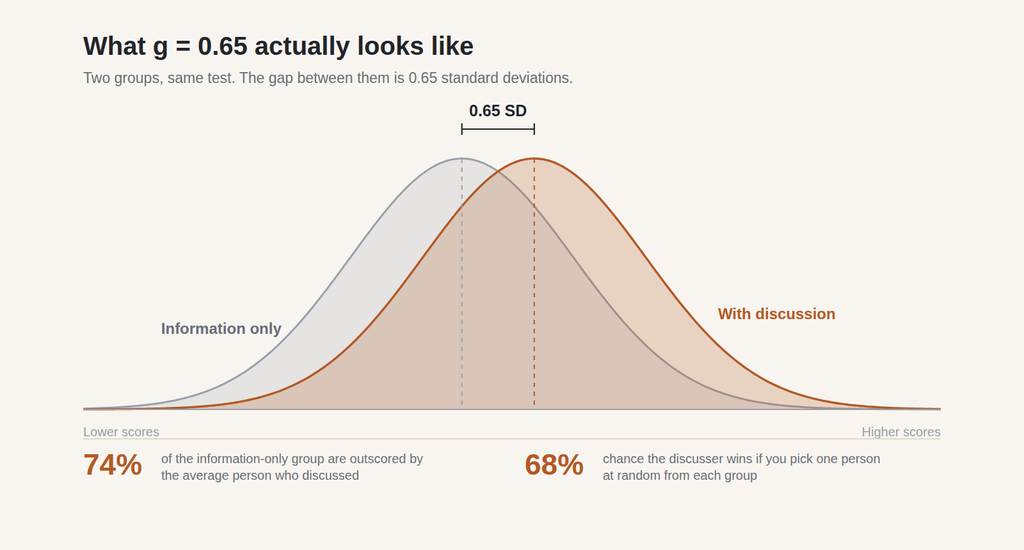
A pooled effect of g = 0.65 (effect size = “how big”) (95% CI [0.49, 0.81], p < 0.001). Geeky, I know, I will explain. Just know that this number is large by education standards.
The moderator is the interesting bit. Interventions with added student discussion were more effective than those “relying solely on unidirectional or passive information transfer”.
What moved was moral sensitivity, judgement and motivation. Character development was inconclusive.
Caveat – (before you put this in a business case) only one of the 92 studies was rated low risk of bias, and the population is students, not employees. Transfer to a workplace compliance audience is a reasonable inference, not a finding.
Here is what changed my mind.
First, this is not a 70/20/10 finding.
70/20/10 is a claim about where development comes from across a career: experience > then social > then formal. It has always been on soft evidential ground anyway, having come out of retrospective survey work with executives in the late 1980s rather than anything controlled.
This meta-analysis sits entirely inside the formal 10.
Discussion here is not the 20 beating the 10. It is a design feature within a structured intervention, and the finding is that the structured intervention works at g = 0.65 (effect size) when it includes discussion.
That says formal learning design is worth funding – yet the solo asynchronous module is the weak build of it.
Second, the number is the news, not the direction.
Most of us have believed this for years and could not price it. Believing something and being able to put a defensible figure next to it in a proposal are very different positions to negotiate from.
Third, belief has not changed practice.
Everybody in this industry “knows” discussion works. The industry still ships passive compliance modules by the million, every year, in every sector. I build them all the time. When a belief has been widely held for twenty years and has not changed what gets built, the constraint was never the belief. It was that nobody could justify the cost of the better build against a cheaper one that ticks the same box.
Evidence that reprices the alternative is useful precisely because of that.
If you hold the budget, two things follow:
You are probably buying the weaker build of something that works. Compliance and ethics is the highest volume category in corporate learning, and it is almost always commissioned as the exact intervention this study says underperforms: a self paced module that transfers information, followed by a knowledge check. Not because anyone thinks it is best, but because it is procurable, auditable and cheap per head.
Your reporting cannot see the thing that moved. The outcomes that improved were sensitivity and judgement. Completion rates and multiple choice scores do not measure that. If your compliance dashboard is green and your conduct incidents are not falling, that is not a mystery. You are measuring the wrong end of the intervention.
Learning Leaders – what to do about it:
WHAT
HOW
Pick one high stakes program.
Most likely conduct, safety or ethics, and re-scope the next build. Same budget, different split: less production polish, more facilitated discussion, even if that means a 45 minute team conversation instead of a 20 minute module.
Add one judgement measure before you rebuild anything.
Two ambiguous scenarios, “what would you do and why”, scored on the reasoning. You need the baseline more than you need the new module.
Change what you ask vendors for.
If you ask for a module, you will get a module. Specify the outcome and the discussion mechanism, and see who can actually build it.
Push back on completion as a headline metric.
Do it with your own executive. This study gives you the language to do it without sounding like you are avoiding accountability.
Forinstructional designer: If you build the thing.
Design the e-learningas the stimulus. The module carries the case, the ambiguity, the consequence. The conversation carries the judgement work.
Build for the facilitator as much as the learner. Discussion guides, debrief structures and observation rubrics are the products almost nobody makes well.
Ask people to commit before revealing the answer – then display how peers responded and the reasoning behind the minority position. You preserve the cognitive tension that makes discussion effective, but at scale and without a facilitator.
The trap in all of this is concluding that discussion means facilitation = a person in a room billing hours. That is the expensive read, and it is the one that gets the idea rejected. The design problem worth solving is how to manufacture the conversation without needing to be in it.
Basarkod, G., Cahill, L. S., Burston, A., Barnett, D., Mahoney, J., Griffith, S., Swaryandini, G., Bradshaw, E. L., Devine, E. K., Akhtaruzzaman, M., Dicke, T., Wilks, M., Slattery, P., Saeri, A. K., Grundy, E. A. C., Lonsdale, C., Marsh, H. W., Chambers, S. K., & Noetel, M. (2026). Educational interventions are effective in improving students’ ethical and moral outcomes: A systematic review and meta-analysis. Nature Human Behaviour. Advance online publication. https://doi.org/10.1038/s41562-026-02456-x
Every year, a significant amount of money is spent on bringing firefighters from all over the country to train in specialised learning facilities of the Australian Rescue Firefighters Services (ARFFS) in Melbourne. With Airservices Australia revising their structure and budget, one of the initiatives I was lucky to participate in was an augmented reality training programme, developed mostly by our in-house coding guru, Ray.
All the risks, none of the danger.
Whenever your training needs involve a situation that is either very expensive or dangerous, extended reality (XR) training is a strong candidate solution, e.g., virtual or augmented reality. In our case, it was both expensive and dangerous. Setting aeroplanes on fire or exploding engines is not something the organisation would look forward to – especially training new staff on a regular basis.
Enter Augmented Reality (AR) simulations.
With training built in a 3D environment, you get to set any number of aeroplanes on fire, explode any engines, load any aircraft model in the simulation, etc. The other and better alternative is learning how to safely extinguish the fire, not let the engine explode and save the virtual people, which is your ultimate goal.
Why does it work so well?
There are several ways to answer that question. Besides the obvious cost savings and health safety, learners engage more and learn better and faster than with any other medium.
→ A cool explanation (based on research, neuroscience and psychology): Work by Mel Slater and Maria V. Sanchez‑Vives and others shows the brain does not fully distinguish between real and virtual bodies when sensory cues are aligned. This supports the idea that the “thinking brain” (prefrontal, reflective systems) can know it is simulated, but subcortical and sensory systems (amygdala, insula, somatosensory cortex) still respond as if it were real, driving emotion, arousal, and encoding into memory.
→ (In English, please) That means, even though you consciously know the training is a fake simulation, your sensory brain still gets you the full experience. On well-designed trainings, you are there! The situation must be addressed. And if you succeed, you will not only learn but also remember what you had to do and how it made you feel.
And the stats keep coming, showing XR works well.
A PwC study on VR soft‑skills training found VR learners were up to 4 times faster to train than classroom learners, more emotionally connected to content, and reported 275% higher confidence in applying skills.
Case reports from fire and safety training providers using XR show higher motivation, repeated voluntary practice, and better recall of life‑saving procedures compared with traditional fire safety instruction.
A few weeks back, a good friend invited me to join him on a quest to learn French, so I said, “Sure!”—as you would. I suggested, instead of learning a bunch of French words, how about we learn the history of art in French, so it’s more interesting? Part of the deal was me proving to myself I could put an e-learning package together in Adapt, a great tool I’ve known for years but never got to properly use until now.
A few prompts down and bam! The bot got it just right.
It wasn’t quite the case with Leonardo and La Gioconda above. With this one I started with Consistent Character and ran the prompt about five times, and it was close but not quite there. So I took it to ChatGPT: no luck. Tried Gemini: same, no luck. Took it to Gwen, and it worked in the second iteration. Sounds painful, but that was actually a few minutes. There it was, Leonardo painting the Mona Lisa. Just like that—type, type, click, done.
The damn bot draws way better than I ever could. And fast!
History of Art (from the history lens)
I didn’t want a training where you see a bunch of information, some paintings with their authors, dates, locations, etc. That’s purely data, and we don’t learn like that. We learn better when we can make connections. So, my approach was to look in the history and learn the forces behind the canvas.
Adapt framwork – l’histoire de l’art
For instance, why does the Romanesque architecture seem so bleak and simple? Why do the churches look like fortresses? It’s because quite often they needed to act like one. The violence was rampant and the raids happened often, so the churches had really thick, unshakable walls. They were there to offer protection. That is the kind of information that helps you understand what drove the artists to do what they did, e.g., power shifts, war, plague, etc. Why did Raphael paint so many religious pieces? Because a lot of them were commissioned by the pope and funded by the Vatican, that’s why.
Raphael didn’t break rules – he perfected them.
A less cartoony version was on the list
For kids (and for me), cartoon characters make learning more fun. They talk to you; they’re funny, quirky and yet somewhat believable – they were born to represent an idea, and they deliver it. Yet, there are some people that will not engage with learning if it doesn’t feel real. I’ve seen stakeholders scoff at storyboards because the characters were fictitious, such as superheroes or aliens, even though the learning material was solid.
With that in mind, I decided to make a more photorealistic version of the same illustrations I already had.
Click the images below to see them better.
Image gallery
The images below are all AI-generated, bringing ideas to life in a way never possible before.
Watching Dead to Rights (南京照相馆, Aug 2025) last weekend left me shaken. There’s one scene I can’t unsee: a soldier smashing a baby to the ground, then killing her with a bullet to her head, so that she would stop crying. I looked away, but the image stayed. My first thought was: Everyone should watch this!
See how quickly humanity can dissolve. Learn from it.
Now, should everyone watch it?
The truth is that some will never do, especially those with vested interest in wars, be it profit, prejudice, power-grabbing, or what have you. Others might watch but take away the wrong lesson, like renewed hatred. If you leave hating a nationality rather than understanding how dehumanisation works, you’ve missed an important point.
Then, there are those with a bad history of trauma or abuse that could be easily triggered into a downward spiral. They should be spared or, at least, mindful if they decide to brave such confronting scenes.
We love to make monsters of our enemies. It’s comforting to think evil is someone else, or something non-human — freaks, demons, pigs — because it spares us the unbearable truth: ordinary people do commit atrocities. Myths, nursery rhymes, and even the “devil made me do it” excuse all serve this displacement. The guilt is too heavy to own, so we push it outward.
From a learning design lens
(I know, but bear with me) Films like this can be transformative, but perhaps if we prepare the audience, give them context, and guide them through reflection. Without that, it risks being pure shock – and gosh, was I shocked. With the right scaffolding, though, it can teach not just history, but the mechanics of cruelty and the fragility of morality.
The film is great, don’t get me wrong, but I feel they could have done more to show nuance — dissenters, conflicted soldiers — to make clear that cruelty is a choice, not a cultural or national trait. Because if we leave thinking “they” are the monsters, we’ve learned nothing.
When Netflix launched the show 13 Reasons Why, it sparked concern amongst mental health professionals for its graphic depiction of teen suicide. In response, they added:
warning announcements by cast members before episodes, explaining the sensitive content and advising viewers to seek help if needed
A companion website offering resources, discussion guides, and crisis hotline links
An after-show (“Beyond the Reasons”) featuring cast discussions with mental health experts
Soundtrack proceeds donated to organisations supporting mental health and suicide prevention
A broad toolkit for educators, parents, and clinicians designed to guide responsible discussions around the theme
Although the first season included only content warnings, these additional measures showed a growing commitment to mitigating harm and fostering reflection.
In the spirit of art imitates life, and vice versa, we have plenty of examples today of narratives dividing from neighbourhood to entire nations. It usually makes a divide between us, the righteous, and them: the terrorists, or the ones stealing our jobs, or the foreigners that don’t belong here, and the list goes on. Sounds familiar?
Blaming monsters is easy.
Remembering honestly, not so much. It forces us to see that the same hands that cradle babies can also kill them — and that preventing that descent is our job. It’s everyone’s job. Every day.
Many years ago, I started learning Buddhism. Not as a religion, just the rational concepts resonate with my way of thinking. One of the core ideas I struggled with for a long time is the detachment of the self, e.g. letting go of the need to be accepted or of being right and taking the seat of the observer.
It’s a reflective question rooted in a practical concern, yet linked to a longing for truth:
How can I practise Buddhist equanimity – without becoming a doormat or a monk? How does anyone live wisely and skilfully in a corporate jungle that doesn’t reward detachment but rather performance, validation, and constant proof of competence?
Think about it: how can one detach itself, for instance, drop the need to be seen as competent in a corporate organisation? Will that leave you wise yet unemployed?
Detachment ≠ Disengagement
One of the most common misunderstandings of Buddhist detachment is the idea that it leads to apathy, passivity, or loss of ambition. But true detachment is non-attachment to outcomes, not non-action.
You can still strive for excellence, care about your work, communicate assertively, build a reputation, etc., but with equanimity—that inner balance where you no longer depend on the validation of others to confirm your worth or panic when things don’t go your way.
So, it’s not about being “unaffected” like a monk hiding in the hills, but about being grounded like a stormproof tree—roots deep in values, flexible branches, not brittle ego.
Here’s a practical path to turn understanding into embodied wisdom—without losing your job, sanity, or ambition:
1. Reframe competence as contribution
Instead of clinging to being seen as right, focus on being of service. That mindset removes ego while still producing excellence. This shifts you from ego-based proving to value-based contributing.
2. Practise “Mini-Meditative Pauses” in meetings
Corporate life is performance theatre. It’s easy to get caught in quick reactions. A Buddhist-inspired method is to train in response vs. reaction. Before answering a challenging question or defending a point, take a silent 3-second breath. Let that breath anchor you. (3rd Space, anyone?)
This gives your nervous system a reset and puts space between stimulus and response—classic mindfulness meets executive presence.
3. Cultivate a “Wise Witness” Journal
At the end of each day, reflect on:
One moment where you reacted from ego
One moment where you responded from presence
One thing you let go of, even if you felt the urge to control
4. Set “Inner KPIs”
KPIs measure your corporate performance. But what about inner metrics?
Did I speak from a place of clarity or insecurity today?
Was I driven by curiosity or fear of being wrong?
Did I uphold my values, even when it cost me validation?
The idea is to turn wisdom into a high-performance practice—not a retreat.
5. Use Role Models Strategically
Not everyone in the corporate world is a narcissist or a bulldozer. Some play the game wisely, with grace.
Who around me seems calm and respected?
What do they do that I can observe, mimic, and adapt?
Can I emulate their “wise assertiveness”?
This balances aspiration with grounded modelling. Wisdom can be a sharp suit with emotional regulation.
Mastery in the modern world is not about renouncing the ego but regulating it.
It’s not about denying ambition but about turning it from a source of stress into a vessel for impact.
This isn’t about escaping the game. It’s about learning how to play it without letting the game play you.
Ask yourself:
What part of your identity feels most threatened if you’re “not right” at work?
Can you think of a recent time you didn’t get your way, and it turned out better than expected?
Who is a professional role model that you admire for their composure and clarity?
Are there recurring emotional triggers at work? (e.g., being interrupted, being questioned)
If you could act from deep inner confidence instead of approval-seeking, what would change?
The sky is always there
One analogy that works well for me is that we are the sky – well, strive to be. The great storms, happy rainbows, gloomy clouds, etc., are just that: weather. They come and go. You, as the sky, are bigger, vast, unshakeable, unflappable.
The real power is knowing the sky is still there even when it’s hidden behind clouds, e.g., feedback, friction, or performance reviews. You’re not renouncing ambition—you’re reclaiming your centre.
You don’t need to become a monk → just a storm-savvy skywalker. Easy :)
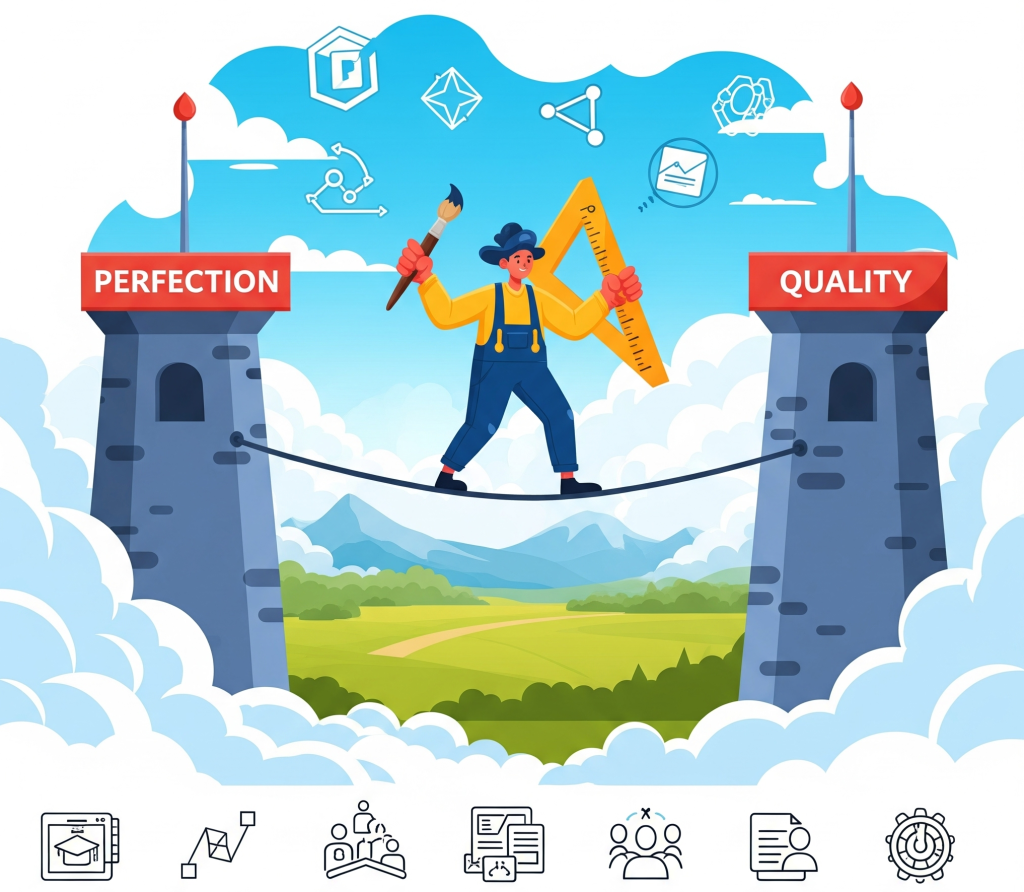
We’ve all been there: another round of feedback, a set of minuscule changes, the deadline looming… In learning, as with any industry, the pursuit of perfection often becomes a double-edged sword. While “perfect is the enemy of good” might sound cliché, it’s a mantra worth remembering. How do I know that? I was guilty of this sin.
Remember, the goal is to create effective learning that delivers real results. Sometimes, that means launching a module that’s at 90% rather than endlessly pursuing that elusive 100%.
The hidden costs of perfectionism
Let’s talk about the elephant in the room: over-testing.
How many times have you found yourself in an endless cycle of reviews, where each stakeholder adds their layer of scrutiny? What started as a straightforward module becomes bogged down in multiple rounds of testing, each applying increasingly strict criteria that weren’t part of the original scope.
Consider this scenario:
Your team has developed a compliance training module. The content is solid, the interactions are engaging, and the learning objectives are met. Yet, the project is three weeks behind schedule because:
Legal wants another review of every screen
The compliance team has new scenarios to add
The brand team needs all colours to be exactly 2% darker
Someone spotted a full stop that should be a semicolon
Sound familiar?
Striking the Right Balance
1. Define “Good Enough” Early
Work with stakeholders to establish clear acceptance criteria at the project’s outset. Document:
Essential compliance requirements
Minimum technical specifications
Core learning outcomes
Acceptable quality thresholds
2. Implement a Staged Review Process
Rather than waiting for everything to be perfect:
Conduct early prototype reviews
Use rapid development cycles
Get stakeholder sign-off on content before visual design
Lock down feedback stages with clear deadlines
3. Focus on Learning Impact
Ask yourself:
Will this change significantly improve learning outcomes?
Is this feedback addressing a genuine learning need?
Could this time be better spent on other aspects of the project?
Ask the team:
Are we testing the right things?
Does this feedback cycle add value?
What’s the cost of delay vs. the benefit of changes?
How will learners benefit from these revisions?
4. Adopt Agile Principles
Even in traditional waterfall environments, you can:
Release minimum viable modules
Gather learner feedback early
Plan for post-launch improvements
Track and measure actual usage patterns
5. Build Quality into the Process
Instead of endless testing:
Create robust design templates
Develop style guides and standards
Use automated quality checks where possible
Implement peer review systems
For Learning Designers
Set Clear Boundaries
Establish feedback deadlines
Limit review rounds
Document scope changes
Communicate the impact on timelines (Do it!)
Prioritise Feedback
Critical → affects learning outcomes or compliance, e.g. accuracy
Important → impacts user experience
Nice-to-have → aesthetic preferences
Document Trade-offs. When pushing back on perfectionism, highlight:
Budget implications
Timeline impacts
Opportunity costs
Learner benefits
Focus on Continuous Improvement
Plan for version updates
Track user feedback
Monitor completion rates
Measure actual performance impact
Quality in learning design is about impact.
By establishing clear standards, implementing efficient processes, and maintaining focus on learner outcomes, we can create high-quality solutions without falling into the perfectionism trap.
The next time you find yourself in the endless review cycle, remember: sometimes good enough is better than perfect, especially when “perfect” means missing deadlines, exceeding budgets, or losing sight of what matters: helping people learn effectively.