
The Learning Blueprint
Know exactly what to build, before you spend a cent building it.
Two weeks, fixed price, no surprises. You get a scoped, evidence-based design your team can build from with anyone.
The problem
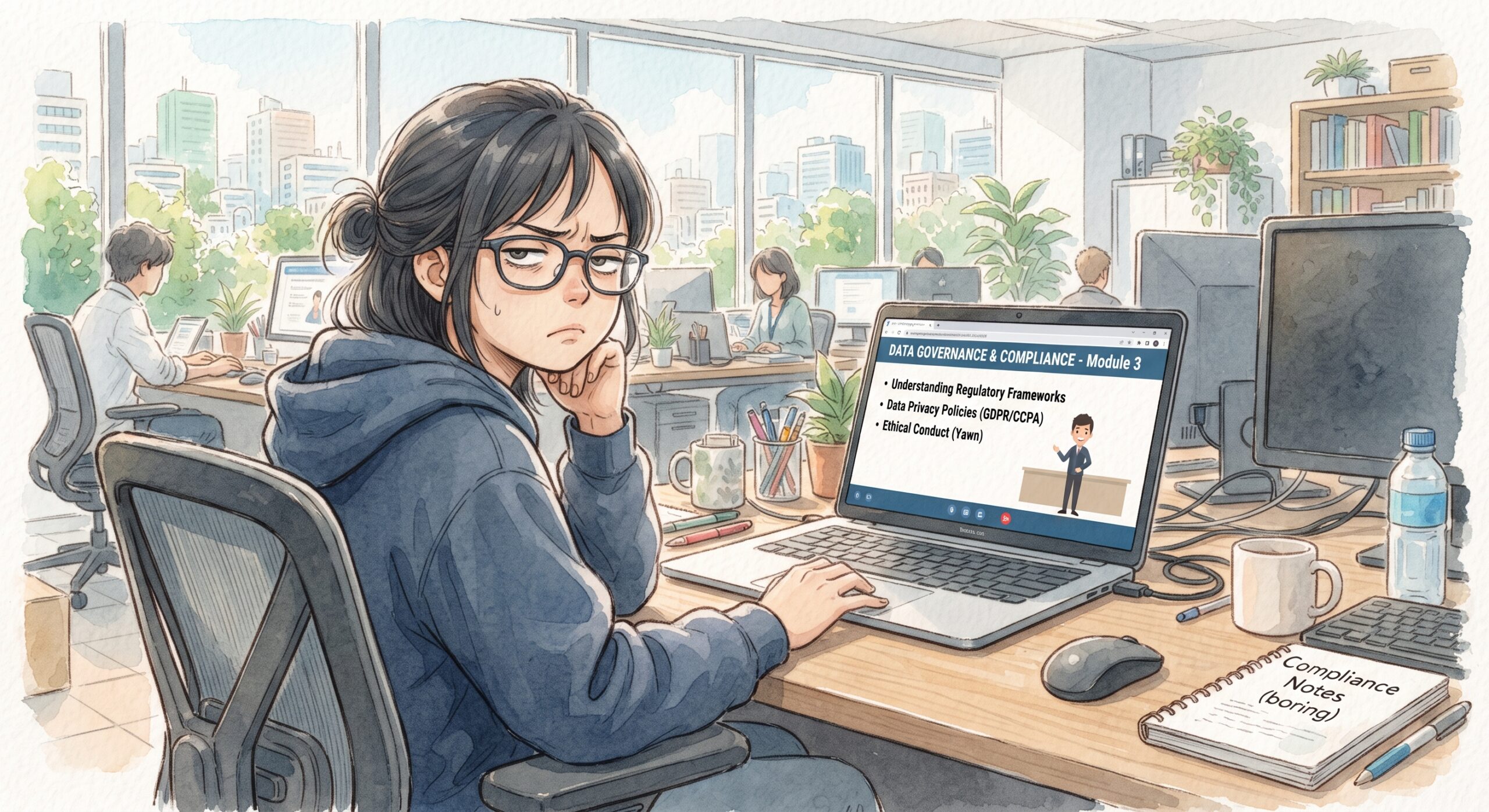
Most training programs fail before anyone opens the first slide.
Not because the build was bad. Because nobody asked the right questions at the start.
Someone hands over a 60-page policy and asks for a course. Six weeks and a five-figure invoice later, the module goes live, completion rates look fine, and nothing changes on the floor.
The problem is that no one defined what people actually need to do differently, and whether training was the right answer at all.
What you get
A design document, not a proposal.
By the end of week two you own a Blueprint containing:
- The behavioural goal. A business outcome you can point to, tested against what’s realistically measurable in your organisation, signed off by your nominated decision-maker.
- The target behaviours. What people need to do differently.
- The cause analysis. Whether each gap is environment, knowledge, skill or motivation, and which of those training can actually fix, based on what your stakeholders and SMEs tell us. If the real answer needs input directly from the people doing the job, the Blueprint will say so and scope that as a short add-on rather than a guess.
- The activity map. Practice activities and scenarios matched to each behaviour, with the supporting information attached to the activity.
- The media and technology plan. What format each piece should take, and what it needs to run on: Storyline, Rise, H5P, video, job aid, facilitated session, or nothing at all.
- A “don’t build this” list. The content that should be a job aid, an email, or a management conversation instead of a course.
- A build estimate. Realistic effort and cost ranges for producing it, so you can budget or tender with confidence.
It’s yours. Take it to your internal team, to a vendor, to a tender panel, or bring it back to me. The estimate and the “don’t build this” list are the same either way.
How it works
Two weeks. Four touchpoints. Minimal load on your team.
Before day 1: Scheduling
You nominate a decision-maker and lock in workshop attendees before the clock starts. Workshop dates get confirmed here.
Day 1: Kick-off (60 minutes)
We agree the scope and what “success” would look like 12 months out.
Day 2: Thinking time (for me)
I prepare for scoping.
Days 3 to 4: Action mapping workshop (half day)
Your SMEs and stakeholders in one room, virtual or in person. This is where we turn content dump into behaviours. Stakeholders contribute; your nominated decision-maker signs off.
Days 5 to 8: Design and drafting
I do the work. You do nothing.
Day 9: Walkthrough (60 minutes)
I present the draft Blueprint, you challenge it, we mark up what needs to change.
Day 10: Final delivery
Revised Blueprint delivered as a PDF plus editable source. One consolidated round of revisions is included – one batch of feedback, however many points it contains.

Published prices
No discovery call required to find out what it costs*.
Module
Starting point - best for one course or topic- Workshop: 2h
- Timeline: 1 week
- Stakeholder: Up to 3
- Decision-maker (sign-off): 1
Course
Best for a full course with multiple stakeholder groups- Workshop: Half day
- Timeline: 2 weeks
- Stakeholder: Up to 8
- Decision-maker (sign-off): 1
Program
Best for a curriculum** or multi-module program- Workshop: Two half day
- Timeline: 4 weeks
- Stakeholder: Up to 15
- Decision-maker (sign-off): 1
*All three tiers produce a Blueprint document. All prices in AUD, excluding GST. 50% on booking, 50% on delivery.
Build credit. If you engage me to produce the learning within 90 days of delivery, 50% of your Blueprint fee comes off the build.
**Program tier scope note. “Curriculum” means up to 4 modules sharing one behavioural goal. Anything larger is quoted separately so the fixed price stays fixed.
So we're clear on the boundaries.
What this is not
The Blueprint does not include: building the course, writing final content, producing video or 3D, LMS configuration, SCORM packaging, translation, or ongoing evaluation. Those are separate engagements, and the Blueprint will tell you roughly what they’ll cost.
I also won’t pretend training is the answer when it isn’t. If the analysis says your problem is a broken process or a management issue, that’s what the Blueprint will say. You’ll have saved considerably more than you paid me.
Who this is for
This works best if you’re:
- An L&D or HR lead with a training request you suspect is really a content dump.
- A safety, compliance or operations manager who needs behaviour to change.
- A consultancy or agency that has won learning work and needs a design partner behind the scenes (white-label available, ask me).
- Anyone about to spend $20,000 or more on a build and wanting to be sure it’s the right build.
Why me?
Over 30 years designing experience, with 10 in learning.
I’ve designed and built learning for Brisbane City Council, BHP, BioLab Australia and others: code of conduct, contract management, information security, field leadership, city resilience. Branched scenarios, serious games, custom 3D characters, the lot.
Which means the Blueprint is written with feasibility in mind, so the estimates are honest and the design is producible. I work with action mapping (credit to Mrs. Moore) because it starts with what people need to do, rather than what someone wants to tell them.

FAQ
Can't we just skip to the build?
You can – most people do. It’s why so many courses get built twice.
What if we already have the content?
Perfect. The Blueprint tells you which 20% of it earns its place and what to do with the rest.
What if we don't have data to measure the outcome against yet?
That’s okay. The Blueprint will name the outcome and tell you what to start tracking, even if the baseline doesn’t exist yet.
Do you run the workshop in person?
In Brisbane, yes, at no extra cost. Elsewhere in Australia, virtually, or in person with travel at cost.
We're an agency. Can you white-label this?
Yes. Your logo, your client relationship, my analysis. Ask me for agency rates.
What if the Blueprint says we don't need training?
Then it’s the cheapest advice you’ll get this year.