

A meta-analysis landed last week and my first reaction was: so what? Then, looking further, it does get interesting.
Ninety two randomised trials found that ethics and moral education works better when people talk to each other than when you push information at them. Pause for “so-what” reaction… Okay, we have known that for decades, e.g. 70/20/10.
Then I came back to it, and I think a lot of us are about to make the same mistake with it.
What the study actually found
Published in Nature Human Behaviour on 26 August, a team including researchers at the University of Queensland pooled the randomised evidence on interventions designed to shift ethical and moral outcomes.
- 92 randomised controlled trials, 12,693 students, 381 effect sizes.
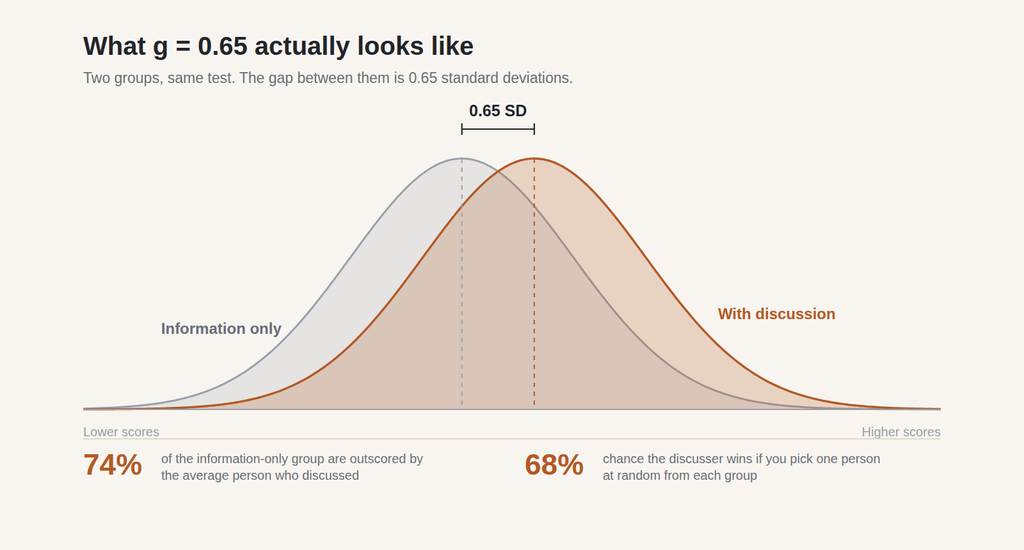
- A pooled effect of g = 0.65 (effect size = “how big”) (95% CI [0.49, 0.81], p < 0.001). Geeky, I know, I will explain. Just know that this number is large by education standards.
- The moderator is the interesting bit. Interventions with added student discussion were more effective than those “relying solely on unidirectional or passive information transfer”.
- What moved was moral sensitivity, judgement and motivation. Character development was inconclusive.
Caveat – (before you put this in a business case) only one of the 92 studies was rated low risk of bias, and the population is students, not employees. Transfer to a workplace compliance audience is a reasonable inference, not a finding.
Here is what changed my mind.
First, this is not a 70/20/10 finding.
70/20/10 is a claim about where development comes from across a career: experience > then social > then formal. It has always been on soft evidential ground anyway, having come out of retrospective survey work with executives in the late 1980s rather than anything controlled.
This meta-analysis sits entirely inside the formal 10.
Discussion here is not the 20 beating the 10. It is a design feature within a structured intervention, and the finding is that the structured intervention works at g = 0.65 (effect size) when it includes discussion.
That says formal learning design is worth funding – yet the solo asynchronous module is the weak build of it.
Second, the number is the news, not the direction.
Most of us have believed this for years and could not price it. Believing something and being able to put a defensible figure next to it in a proposal are very different positions to negotiate from.
Third, belief has not changed practice.
Everybody in this industry “knows” discussion works. The industry still ships passive compliance modules by the million, every year, in every sector. I build them all the time. When a belief has been widely held for twenty years and has not changed what gets built, the constraint was never the belief. It was that nobody could justify the cost of the better build against a cheaper one that ticks the same box.
Evidence that reprices the alternative is useful precisely because of that.
If you hold the budget, two things follow:
- You are probably buying the weaker build of something that works. Compliance and ethics is the highest volume category in corporate learning, and it is almost always commissioned as the exact intervention this study says underperforms: a self paced module that transfers information, followed by a knowledge check. Not because anyone thinks it is best, but because it is procurable, auditable and cheap per head.
- Your reporting cannot see the thing that moved. The outcomes that improved were sensitivity and judgement. Completion rates and multiple choice scores do not measure that. If your compliance dashboard is green and your conduct incidents are not falling, that is not a mystery. You are measuring the wrong end of the intervention.
Learning Leaders – what to do about it:
| WHAT | HOW |
| Pick one high stakes program. | Most likely conduct, safety or ethics, and re-scope the next build. Same budget, different split: less production polish, more facilitated discussion, even if that means a 45 minute team conversation instead of a 20 minute module. |
| Add one judgement measure before you rebuild anything. | Two ambiguous scenarios, “what would you do and why”, scored on the reasoning. You need the baseline more than you need the new module. |
| Change what you ask vendors for. | If you ask for a module, you will get a module. Specify the outcome and the discussion mechanism, and see who can actually build it. |
| Push back on completion as a headline metric. | Do it with your own executive. This study gives you the language to do it without sounding like you are avoiding accountability. |
For instructional designer: If you build the thing.
- Design the e-learning as the stimulus. The module carries the case, the ambiguity, the consequence. The conversation carries the judgement work.
- Build for the facilitator as much as the learner. Discussion guides, debrief structures and observation rubrics are the products almost nobody makes well.
- Ask people to commit before revealing the answer – then display how peers responded and the reasoning behind the minority position. You preserve the cognitive tension that makes discussion effective, but at scale and without a facilitator.
The trap in all of this is concluding that discussion means facilitation = a person in a room billing hours. That is the expensive read, and it is the one that gets the idea rejected. The design problem worth solving is how to manufacture the conversation without needing to be in it.
Reference
Basarkod, G., Cahill, L. S., Burston, A., Barnett, D., Mahoney, J., Griffith, S., Swaryandini, G., Bradshaw, E. L., Devine, E. K., Akhtaruzzaman, M., Dicke, T., Wilks, M., Slattery, P., Saeri, A. K., Grundy, E. A. C., Lonsdale, C., Marsh, H. W., Chambers, S. K., & Noetel, M. (2026). Educational interventions are effective in improving students’ ethical and moral outcomes: A systematic review and meta-analysis. Nature Human Behaviour. Advance online publication. https://doi.org/10.1038/s41562-026-02456-x